Nvidia (NVDA) reported fiscal 2026 fourth-quarter earnings of $1.62 per share (+82.0% year over year) on revenue of $68.1 billion (+73.2% YoY) and guided to fiscal 2027 first-quarter revenue of $78.0 billion, plus or minus 2%, as the leader of the AI boom topped Wall Street expectations for all three metrics once more.
The results came at an opportune time, "as investors were extremely hungry for confirmation that AI is still a positive storyline for stocks, and Nvidia's blowout earnings did just that," says James Demmert, chief investment officer at Main Street Research. "We believe that the positive force that AI is sparking in Nvidia's earnings will overpower the negative force that AI is causing in the software space."Demmert adds that we are currently in an "AI and tech-led bull market that favors hardware and infrastructure stocks, and Nvidia is at the center of this."
The Kiplinger team reported on Nvidia's fourth-quarter earnings report, bringing you the news and our expert analysis of what the results could mean for you and your portfolio. Scroll for the latest updates.
If You'd Put $1,000 Into Nvidia Stock 20 Years Ago, Here's What You'd Have Today | Here's the Truth About Using AI to Plan Your Retirement | Amid Mounting Uncertainty: Five Forecasts About AI
Refresh Get notified of updates 2026-02-23T14:54:52.418ZNvidia stock trades higher to start earnings week
Nvidia stock opened higher Monday morning, up 1% at last check. The positive price action comes after Aletheia Capital upgraded the chip stock to Buy from Hold, saying it is "too cheap to ignore." NVDA is up more than 1% for the month to date, and has gained nearly 4% since the start of the year.
Track all markets on TradingViewThis comes as the broader stock market trades lower at the start of the week amid uncertainty over President Donald Trump's tariff plans, with the blue-chip Dow Jones Industrial Average down 0.8%, the broader S&P 500 0.4% lower and the tech-heavy Nasdaq Composite off 0.5%.
2026-02-23T15:09:17.510ZWall Street keeps raising Nvidia earnings estimates
"Earnings expectations for Nvidia are exploding," says John Belton, portfolio manager at Gabelli Funds.
Indeed, analysts have upwardly revised their earnings-per-share estimates for Nvidia's Q4 print three times in the past 30 days.
Belton adds that Wall Street "has become accustomed to very consistent beats and guides above the street," and that "part of the reason for the consistency is that the demand is so high that they're supply constrained, which remains the case."
The portfolio manager believes we "could get a big beat" this time around, but what Wall Street really wants to hear is the chipmaker's guidance beyond this quarter. Specifically, "what is the demand outlook into next year and how long is this cycle going to last," as well as "how high this cycle is going to go."
Belton also suspects the Street will be looking for commentary from Nvidia CEO Jensen Huang on agentic software development. "I think we're going to hear a lot more there, given what Anthropic has recently been releasing. But that seems to be the next new multi-billion-dollar use case for AI."
- Karee Venema
 Karee VenemaSenior investing editor, Kiplinger.com
With over a decade of experience writing about the stock market, Karee Venema is the senior investing editor at Kiplinger.com. She joined the publication in April 2021, and oversees a wide range of investing coverage, including content focused on equities, fixed income, mutual funds, ETFs, macroeconomics and more.
2026-02-23T15:32:27.563ZWhat time is Nvidia's earnings release?
Nvidia will release its fiscal fourth-quarter earnings report after the stock market closes on Wednesday, February 25. The results typically come through around 4:20 pm to 4:30 pm Eastern Standard Time.
The release of Nvidia's earnings report will be followed by a conference call, which will begin at 5 pm EST.
2026-02-23T15:57:17.921ZMeta goes big on Nvidia GPUs and CPUs
On February 17, Meta Platforms (META) and Nvidia announced a major expansion of their partnership. Under the new multi-year agreement, Meta will purchase millions of Nvidia's latest chips, including Blackwell and Rubin GPUs, along with CPUs, networking and security technologies.
Meta has already invested billions in data centers, large language models (LLMs) and AI-driven features for both users and advertisers. This deal strengthens that strategy by ensuring access to the high-performance compute needed to train and run increasingly complex models at scale. The chips will be deployed across Meta's own data centers and supplemented through Nvidia's Cloud Partner ecosystem. This includes providers such as CoreWeave (CRWV) and Crusoe.
Beyond performance, Meta also plans to use Nvidia's Confidential Computing capabilities in services such as WhatsApp. This highlights the growing importance of trust, security and governance.
The agreement, likely valued in the tens of billions, reinforces Nvidia's leadership in AI processors at a time when competitors such as Google's TPUs and Amazon's Trainium are gaining attention. Yet Nvidia's GPUs remain the most flexible option across diverse AI workloads, providing the company a durable competitive edge.
The partnership makes one thing clear: access to advanced compute is becoming the defining advantage in the AI era.
- Tom Taulli
 Tom TaulliKiplinger contributor
Tom Taulli has been developing software since the 1980s. He sold his applications to a variety of publications. In college, he started his first company, which focused on the development of e-learning systems. He would go on to create other companies as well, including Hypermart.net that was sold to InfoSpace in 1996. Along the way, Tom has written columns for online publications such as Bloomberg, Forbes, Barron's and Kiplinger. He has also written a variety of books, including Artificial Intelligence Basics: A Non-Technical Introduction.
2026-02-23T16:31:36.322ZDoes Nvidia pay a dividend?
Nvidia pays a small quarterly dividend of 1 cent per share, which works out to 4 cents per share annually.
Based on the chipmaker's current stock price, this works out to a dividend yield of 0.02%. By comparison, the S&P 500's current dividend yield is 1.1%.
In fiscal 2025, Nvidia paid roughly $834 billion in dividends. It also bought back $33.7 billion in stock.
- Karee Venema
Related: The Kiplinger Dividend 15: Our Favorite Dividend-Paying Stocks
2026-02-23T17:23:26.075ZMorgan Stanley analyst expects "strong results" for Nvidia
Morgan Stanley analyst Joseph Moore says he anticipates "strong results" for Nvidia's upcoming print.
"We expect Nvidia to trade up on good results, with a clear acceleration in near-term drivers, an impactful and accelerating Vera Rubin ramp, and long-term confidence," Moore writes in a February 23 note to clients.
Last quarter, Nvidia reported revenue that was $3 billion more than what Wall Street expected and the company forecast an $8 billion quarter-over-quarter increase to its top line for Q4. Moore says "it does not feel like there's been a deceleration," and he believes the company will beat both its guidance and the Street's forecast.
Moore also thinks a strong ramp in Nvidia's Vera Rubin next-generation, six-chip AI platform will help mitigate any worries over weakness in the share price. He anticipates a strong outperformance from the blue chip stock going forward, as evidenced by his $250 price target, which is more than 30% above current levels.
He adds that "we would be buyers of Nvidia stock into this report."
- Karee Venema
2026-02-23T18:14:15.967ZSoftware's death is greatly exaggerated, says Nvidia CEO Jensen Huang
Not many had a bear market for software stocks on their bingo card for 2026. It has been pervasive, from massive tech companies including Microsoft (MSFT) and SAP (SAP) to smaller ones, such as DocuSign (DOCU) and LegalZoom (LZ). Some on Wall Street have called this the "SaaSpocalypse."
The catalyst for the sell-off came last month, when Anthropic released Claude Cowork, a sophisticated agentic AI system. It allows for developing sophisticated agents without needing to know how to code.
But interestingly enough, Nvidia CEO Jensen Huang thinks that Wall Street is overreacting. At a recent conference, he noted that "there's this notion that the software industry is in decline and will be replaced by AI. It is the most illogical thing in the world."
No doubt, Huang has a pretty good track record when it comes to understanding industry trends.
Yet agentic AI is still likely to result in major changes – and this can be a threat to those software companies that fail to innovate.
"The narrative that AI agents will replace SaaS misses what is actually happening inside companies," says Branden Jenkins, CEO of MAXIO, a developer of an AI-powered subscription platform. "This is not an extinction event. It is a structural shift. Organizations are consolidating tools, scrutinizing spend, and demanding clearer paths to profitability. Every system now has to prove its value."
- Tom Taulli
2026-02-23T19:00:59.272ZJefferies downgrades several software stocks on AI risks
Software stocks have taken it on the chin in recent weeks amid concerns that AI will disrupt business models.
Indeed, the iShares Expanded Tech-Software Sector ETF (IGV), whose top holdings include Oracle (ORCL), Salesforce (CRM) and Applovin (APP), is down more than 27% for the year to date to trade at its lowest price point since late 2023.
This prompted Jefferies analyst Brent Thill to take "a fresh look at current levels" for several software stocks given these AI risks. Thill said he sees "ongoing risk/negative sentiment" for Workday (WDAY), DocuSign (DOCU), Monday.com (MNDY) and Freshworks (FRSH), which he downgraded to Hold from Buy.
However, Thill isn't bearish on all software stocks. He believes Intuit (INTU), Procore Technologies (PCOR), Atlassian (TEAM) and Salesforce are "best positioned to make the AI tech transition" and represent "more durable vendors that are willing to disrupt themselves."
Overall, Thill says "software will survive" because it "helps run businesses and organizations as the code embeds domain knowledge and best practices." He adds that it is more cost-effective for companies to rely on a "few key software vendors" than to develop and maintain every app on their own.
- Karee Venema
2026-02-23T19:48:20.579ZHedge funds bought Nvidia stock in Q4
Nvidia shares underperformed the broader market in Q4, slipping 0.04% on a total return basis (price change plus dividends) vs the S&P 500's 2.4% total return.
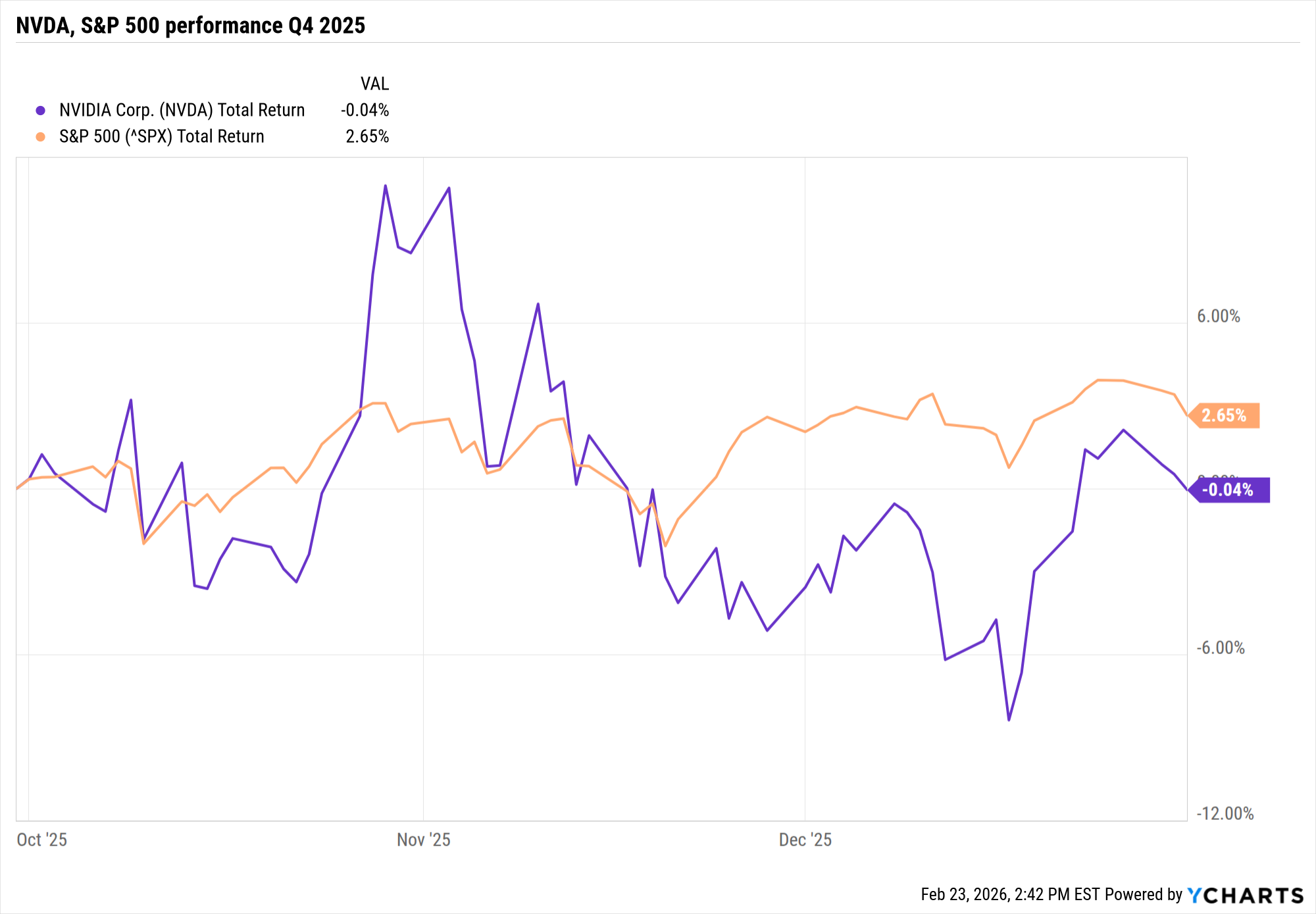
During this October 1 through December 31 time frame, hedge funds were net buyers of Nvidia stock.
According to WhaleWisdom, 86 hedge funds initiated new positions in NVDA in Q4 and 355 increased their stakes. This compares to 29 that closed their positions and 364 that reduced their stakes.
The net change in hedge fund share ownership amounted to 149.3 million shares.
- Karee Venema
Read more: Best Blue Chip Stocks: 21 Hedge Fund Top Picks
2026-02-23T20:51:29.780ZNvidia bets AI will transform industrial cybersecurity
In a February 23 blog post, Nvidia said it is teaming up with several cybersecurity firms on an initiative to bring accelerated computing and AI into operational technology (OT) and industrial control systems (ICS) environments (think plants, utilities, manufacturing and infrastructure). The goal is to allow for real-time detection and response to threats.
Each partner brings a specific layer of capability. Forescout, for instance, will focus on visibility and asset discovery across complex OT environments, while Akamai Technologies (AKAM) will contribute segmentation technology that can isolate workloads and contain threats without disrupting operations.
Siemens and Palo Alto Networks (PANW) will embed security directly into industrial automation systems, and Xage Security will apply zero-trust principles to energy and infrastructure networks.
Generally, OT environments were not built for modern cybersecurity vulnerabilities. Yet as these complex systems get more connected and data-driven, the attack surface expands significantly. But with sophisticated AI, it's possible to analyze massive streams of sensor and network data.
What stands out here is the convergence of AI infrastructure and cyber-physical security. GPUs are becoming part of the defensive stack protecting real-world systems.
For enterprises, this signals a broader trend: cybersecurity is moving from reactive monitoring to AI-driven operational resilience. And in sectors where downtime can impact economies or safety.
- Tom Taulli
2026-02-23T21:47:30.807ZStocks tumble on AI, trade worries
Stocks closed lower Monday as Wall Street worried about the possibility for far-reaching AI disruption. Concerns about the state of global trade following the Supreme Court's ruling invalidating most of President Donald Trump's tariff policies also weighed on the main indexes.
Financial stocks led the way lower, though only five of 11 sectors closed in the red. American Express (AXP, -7.2%) was one of the worst-performing Dow Jones stocks, ahead of only International Business Machines (IBM, -13.1%), while Visa (V, -4.6%), JPMorgan Chase (JPM, -4.2%) and Goldman Sachs (GS, -3.2%) also dragged the price-weighted Dow Jones Industrial Average down 1.7% to 48,804.
The broad-based S&P 500 lost 1.0% at 6,837 and the tech-heavy Nasdaq Composite was off 1.1% to 22,627.
Nvidia gained 0.9% ahead of Wednesday's earnings event.
Read more: Dow Loses 821 Points to Open Nvidia Week: Stock Market Today
2026-02-24T13:43:23.667ZEverybody everywhere wants what Nvidia's got
Equity index futures indicate a positive open for the U.S. stock market a day after rising fear about AI disruption triggered a broad sell-off and a day before Nvidia (NVDA), the leader of that AI-driven economic revolution, reports earnings.
"At a time with tech stocks volatile and greater worries around the AI narrative with the 'AI Ghost Trade' black cloud over tech stocks," Wedbush analyst Dan Ives writes in a morning note, "it all comes down to gauging the AI Revolution demand story which starts and ends with Nvidia."
And its tech is so cutting-edge that a senior Trump administration official told Reuters that China's DeepSeek research lab used Nvidia's most advanced chip, the Blackwell, to train its latest AI model in what would be a violation of U.S. export control laws.
"The U.S. believes DeepSeek will remove the technical indicators that might reveal its use of American AI chips, the official said, adding that the Blackwells are likely clustered at its data center in Inner Mongolia, an autonomous region of China," Reuters reported.
Meanwhile, as Ives notes, when Nvidia and the "Godfather of AI" report on Wednesday we'll "be able to hear a pin drop on Street trading desks as the entire global market will be carefully watching these results and commentary from Jensen."
Nvidia CEO Jensen Huang is unlikely to shed any light on the Blackwells in Inner Mongolia. But he will talk about supply and demand for the AI chips creating and, in some cases, destroying value across sectors and industries.
"We continue to believe Street estimates for Nvidia are being significantly underestimated over the next few years given the global demand story for the AI Revolution," Ives concludes, noting that Big Tech capex will exceed $650 billion in 2026.
The analyst sees "a major boost by more enterprises, governments, and global adoption entering the picture over the next 12 to 18 months with Nvidia's golden chips front and center."
– David Dittman
 David DittmanInvesting editor, Kiplinger.com
I am the former managing editor and chief investment strategist of Utility Forecaster and the former editorial director of Investing Daily, Charles Street Research, and Weiss Ratings. I am also a former stockbroker and have been working in financial media for more than 20 years.
2026-02-24T15:35:09.454ZNvidia earnings will impact prices for all risk assets
Strictly speaking, the three main U.S. equity indexes opened mixed on Tuesday, but the S&P 500 quickly made up its modest loss to join the Dow Jones Industrial Average and the Nasdaq Composite in positive territory.
Nvidia (NVDA) was dragging on the Dow less than an hour into the trading session. International Business Machines (IBM), which was down more than 13% on Monday, was up more than 4% on Tuesday.
Goldman Sachs (GS) had also reversed yesterday's decline, but American Express (AXP), Visa (V) and JPMorgan (JPM) continue to reflect worry about the impact of AI on their businesses.
Consumer discretionary stocks were the best-performing sector after Home Depot (HD) reported expectations-beating fourth-quarter earnings and announced a 1.3% dividend increase.
Tech stocks were also higher by nearly 1%, and industrials were also catching bids, while communication services and health care lagged. But it's all about Nvidia earnings this week. And all sectors will feel the impact.
"NVDA has consistently beaten on earnings," Mizuho Securities Director of Energy Futures Bob Yawger observes, "but if it fails to do so this quarter, look for risk assets to get sucked into an AI downtrend. NVDA would not have the same effect on oil as an Iran nuclear deal, but it does have the ability to weigh on all risk assets."
Noting that the situation with President Donald Trump's tariffs "does not help," Yawger says to look for a "commodity rotation out of oil and into gold and silver if NVDA underperforms."
– David Dittman
2026-02-24T16:48:58.842ZAgentic AI startup founder: Nvidia faces long-term competitive pressures
Over the past two decades, Anurag Gurtu has founded multiple companies, with successful exits to Splunk, Tripwire and Sun Microsystems. He also has extensive experience with machine learning and generative AI.
His latest venture is Airrived. The company is the developer of the Agentic OS, which is focused on cybersecurity, IT and business operations. While the system is agnostic in terms of GPU vendors, his company has worked extensively with Nvidia implementations.
"Nvidia's dominance extends beyond raw silicon performance," says Gurtu. "With next-generation AI GPUs like Blackwell, the deeply embedded CUDA software ecosystem, advanced networking capabilities, and strategic hyperscaler alignment, Nvidia has built a full-stack AI platform that creates powerful switching costs. This is no longer a chip cycle; it is an infrastructure transformation, and Nvidia sits squarely at the center as the foundational engine of the AI-driven global economy."
However, holding onto this dominant position will not be easy. The fact is that the competitive environment is getting more intense.
Organizations are leery of having Nvidia as a single vendor, especially as AI becomes increasingly mission-critical. This means constrained portability and architectural flexibility.
"That's precisely why major cloud providers are investing aggressively in alternative silicon," explains Gurtu. "Google continues to scale its TPU (Tensor Processing Unit) platform to support internal AI workloads and external cloud customers. Amazon has developed Trainium and Inferentia chips to optimize cost and performance for AWS AI services. Microsoft is advancing its own AI accelerators to reduce dependency and improve workload control. Meanwhile, Advanced Micro Devices and Intel are pushing competitive GPU and accelerator roadmaps aimed at narrowing performance and ecosystem gaps."
This does not necessarily mean that Nvidia's growth engine will suddenly hit a wall. Indeed, its momentum appears to remain strong.
But for the next few years, it seems reasonable that the competition will start to weigh on results.
- Tom Taulli
2026-02-24T17:41:59.471ZAMD stock pops on Meta chip deal
Speaking of competitive pressures, Advanced Micro Devices (AMD) is trading more than 8% higher at last check on Tuesday, making it one of the best S&P 500 stocks, after the tech giant said it inked an expanded multi-year deal with Facebook parent Meta Platforms (META).
Track all markets on TradingViewUnder the terms of the agreement, Meta will use up to 6 gigawatts of AMD's AI chips to power its AI infrastructure. Additionally, AMD will issue performance-based warrants that will allow Meta to buy 160 million AMD shares, with the first tranche vested once 1 gigawatt of GPUs and CPUs are shipped.
"Overall, we believe the news improves visibility/reduces tail risk (a big concern in this market for the AI trade), adds conviction to AMD's shift into large-scale solutions, and supports share gain," says CFRA Research analyst Angelo Zino. "The META deal is no surprise given the strong collaboration between the two, but we think it offers greater opportunities with other hyperscalers as AMD demonstrates initial success with Helios."
The news follows last week's announcement that Meta signed a multi-year deal with Nvidia to purchase millions of its AI chips.
- Karee Venema
2026-02-24T18:22:18.709ZWhat should you do with all that appreciated NVDA stock?
Even amid the recent volatility in growth stocks, Nvidia is still up nearly 43% year over year. And that's modest compared to its longer-term returns. Indeed, NVDA has generated an average annual return of 73.6% over the past 10 years, easily outpacing the S&P 500's 15.5% gain.
So what's an investor to do with all of their appreciated Nvidia stock? We turned to Charles Lewis Sizemore, CFA, chief investment officer and Kiplinger contributor, for advice.
One option is to take the money and run. "Having a disproportionate share of your portfolio in any single stock — even one as incredibly successful as Nvidia — is risky," says Sizemore. "Selling or at least trimming the position little by little could be smart risk management."
But selling isn't the only route you could take. In this article, Sizemore shares a few other potential scenarios for Nvidia investors who have capitalized on the stock's impressive run.
Read more: I'm 55 With 10 Years Until Retirement, and I've Made $2 Million on Nvidia Stock. What Do I Do with It Now?
2026-02-24T19:02:35.900ZNvidia's top-tier status will remain intact
There's been a major focus on Nvidia's competitive position in recent quarters, particularly amid Broadcom's (AVGO) strong momentum, says Rolf Bulk, head of semiconductors and infrastructure at Futurum Equities.
But Bulk believes that Nvidia's "relentless" pace of "introducing new architectures" leaves "limited room for hyperscalers and frontier AI labs to launch competitive in-house silicon."
That's not to say threats don't exist, with Google's TPU "being the obvious example," but he thinks Nvidia "should still capture the bulk of AI compute spend this year and next."
Additionally, considering "the AI semiconductor supply chain, demand and the roadmap look on track," Bulk views Nvidia's current stock price and valuation as an attractive entry point for long-term investors.
- Karee Venema
2026-02-24T19:41:53.111ZWhy are Nvidia earnings so important?
Regardless of whether you own Nvidia stock or not, the company's earnings report will be one of the most important and followed this earnings season, says Andrew Rocco, stock strategist at Zacks Investment Research.
Why?
"Not only is Nvidia the largest company on Earth by market cap ($4.6 trillion), but it also provides the most critical and necessary technology to the AI revolution – the coveted graphics processing units (GPUs)," explains Rocco.
And beyond its massive size and "necessity in the supply chain," the strategist says that Nvidia earnings are so important because the report "will provide clues into the health of AI spending in general and ... about the health of its business partners, such as CoreWeave (CRWV) and Nebius Group (NBIS)."
For its Q4 print, in particular, Rocco believes investors "will want to see reassuring comments from Nvidia CEO Jensen Huang that the blistering data center spending from hyperscalers such as Microsoft (MSFT) and Meta Platforms (META) continues."
They'll also be watching for comments on the impact from agentic AI. "Last year, Huang correctly predicted that AI would move from the 'generative' (large language model) phase to the 'agentic' phase," he notes.
- Karee Venema
2026-02-24T20:25:09.610ZNvidia's high-stakes bet on OpenAI: a $30 billion investment and a $100 billion question mark
The buzz is that Nvidia is working on a deal to invest up to $30 billion in OpenAI, according to a recent report from CNBC. The transaction could value the company at a massive $730 billion.
But there is something else. Nvidia is also exploring a $100 billion deal for infrastructure investments for OpenAI, though a late-January report in The Wall Street Journal suggests this deal may be in trouble.
OpenAI's Sam Altman has downplayed this suggestion, posting on X in early February: "We love working with NVIDIA and they make the best AI chips in the world. We hope to be a gigantic customer for a very long time. I don't get where all this insanity is coming from."
Nvidia CEO Jensen Huang has also expressed his confidence in OpenAI.
No doubt, in the world of AI, things can move very quickly. But it seems like Nvidia and OpenAI have much at stake – and need to find ways to make things work.
"For Nvidia, the investment makes a lot of sense and allows them to have greater influence on the value chain," says Marcus Bodet, co-founder of B.I.G. Capital, a private investment firm and family office that specifically invests and acquires tech and software companies. "This will also put them closer to understanding the needs, desires and requirements of the end user and also allow them to help shape what eventual products, features and services are available to the consumer."
- Tom Taulli
2026-02-24T21:31:02.495ZStocks rise ahead of SOTU, Nvidia earnings
Stocks closed higher on Tuesday ahead of President Donald Trump's State of the Union address.
Salesforce (CRM, +4.1%) and International Business Machines (IBM, +2.7%) led the 30 Dow Jones stocks, as AI-related names attracted bargain-hunters. Goldman Sachs (GS, +1.1%) and Visa (V, +0.2%) recovered from Monday's sell-off for financial stocks, though JPMorgan Chase (JPM, -0.1%) and American Express (AXP, -0.3%) struggled again.
Nvidia (NVDA), meanwhile, gained 0.7% ahead of its Wednesday evening turn in the earnings confessional.
As for the main indexes, the Dow Jones Industrial Average was up 0.8% to 49,174, the broad-based S&P 500 had added 0.8% at 6,890, and the tech-heavy Nasdaq Composite was higher by 1.0% to 22,863.
Read more: Dow Absorbs Disruptions, Adds 370 Points: Stock Market Today
2026-02-25T13:18:11.253ZNvidia Day looks good so far
Nvidia (NVDA) was up 0.8% in pre-market trading a little more than an hour before the opening bell on Wednesday. Equity index futures indicate a positive open across the board for U.S. stocks, following through on Tuesday's rally as well as overseas price action early on Wednesday.
The leader of the AI revolution will release its fiscal 2026 fourth-quarter results after the closing bell, at around 4:20 pm ET, and CEO Jensen Huang and CFO Colette Kress will speak about the AI boom during the company's conference call at 5 pm.
"U.S. equity futures are firmer after yesterday’s solid rebound," BMO Senior Economist Sal Guatieri writes, "with investors eying Nvidia’s earnings release after the close today. There was nothing market moving in the President’s State of the Union Address."
As BMO Senior Economist Jennifer Lee notes, "Lots of green on the screens this morning, with chipmakers driving a rally in Asian markets." European markets were also in the green ahead of an earnings announcement it seems the whole world will be watching.
– David Dittman
2026-02-25T13:41:23.647ZFor Nvidia, it's not the quarter, it's the outlook
After tonight's close, Nvidia will report its fiscal fourth-quarter results. Given the recent volatility with tech stocks, the announcement could have a major impact on the market.
So what are top analysts and investors looking for? Here's a look:
Luke Rahbari, co-portfolio manager of the Rational Equity Armor Fund (HDCAX):
"I think the revenue number will probably come in right about where estimates are now. But it's going to be all about the guidance. Even if they beat revenue and beat it by quite a bit, the driving force of the stock will be the guidance for next quarter and the rest of the year. Also, what their spend is going to be — how much they're going to spend and in which partners — that will also be a big tell for the stock and where people expect it to go.
"The guidance has to mention that they're seeing strong demand across the board — not just in one area, but across the board — and that they expect year-to-year growth to continue the way it has been. The biggest thing is going to be data center revenue—the number of chips they're selling, what overseas demand looks like, and whether they think tariffs are going to cut into that or not."
John Belton, portfolio manager at Gabelli Funds:
"The size of the beats over the last couple of quarters has been increasing, so I think you could get a big beat here. I think expectations are pretty high to be fair. I think the magnitude of quarterly revenue growth they've been reporting has also been expanding, so the business has been accelerating. From that standpoint, you should get that sort of indication here.
"Investors aren't questioning Nvidia's capital deployment. I think what they're looking for in the P&L and on the profitability side is what's happening with gross margins, particularly given some of the rises in input costs that we've been seeing across the supply chain. Last quarter, they got it to holding mid-70s gross margins this year and that was a very positive message. We're definitely going to have to hear them repeat that message."
– Tom Taulli
2026-02-25T14:51:14.305ZWhat does Nvidia's AI revolution mean for society?
Tech stocks appear to have recovered from the damage done by a report about the collateral impact of artificial intelligence on specific sectors, industries and stocks from Citrini Research that even its founder describes as a "worst-case scenario."
But, as James van Geelen says in an interview with Bloomberg, "The market is clearly jumpy about this." Stocks sold off hard on Monday but bounced back on Tuesday.
Nvidia (NVDA) is up 1% about 15 minutes into the trading session ahead of its post-closing-bell earnings announcement, and the Nasdaq Composite is higher by 0.7%. The Dow Jones Industrial Average and the S&P 500 are well in the green, too,
Van Geelen, who first came to Wall Street's attention when he wrote about his Silicon Valley Bank short in 2022, says the Substack post "served as a focus point for investors who were already concerned about the second-order disruption to incumbents by AI."
He said he only intended to start a conversation about a technology with the potential to wreak widespread havoc on peoples' lives. "If you're the most bullish on AI disruption, what happens after that?"
Van Geelen also frames a fundamental challenge: "As a society, we really need to wrestle with the fact that over the course of history, the most productive kind of asset has always created jobs for humans."
– David Dittman
2026-02-25T15:23:32.923ZThe Nvidia bear states his case
"We think Nvidia (NVDA) will meet expectations, but it is hard to see them delivering much upside in light of TSMC capacity," Seaport Research Partners analyst Jay Goldberg writes in a note ahead of the post-closing-bell earnings event that will settle, for now, whether we're in an AI boom or an AI bubble.
Goldberg cites supply-chain problems caused by backups at Taiwan Semiconductor Manufacturing's (TSM) chip assembly lines. He's also the only analyst on Wall Street with the courage to stick a Sell rating on the leader of the AI revolution.
"We see Nvidia facing growing competitive pressure," Goldberg wrote in December. "To address this, the company has been leaning on a variety of sales mechanisms to adapt."
As the analyst explains, "These measures are not fully reflected in financials, but they are already material and look likely to grow significantly next year. We remain negative on Nvidia as signs of competition increase."
Goldberg, who has criticized many of the recent big deals driving the AI narrative, reiterated his Sell rating and his $140 12-month target price.
“It's not circular, but it's kind of like a dodecahedron,” Goldberg told Marketplace. “It’s a shape that is starting to kind of resemble a circle. If it goes on much longer, it will become a circle, but we’re not quite a circle yet.”
Of the 63 analysts who cover Nvidia, 60 rate it a Buy and two rate it a Hold. Goldberg says the leader of the AI revolution is a Sell at these levels.
– David Dittman
2026-02-25T16:45:04.693ZTech leads so far on Nvidia Day
Technology continues to lead as we approach midday, with financial stocks also up more than 1%.
Nvidia (NVDA) is up 1.8%, while International Business Machines (IBM) leads the 30 Dow Jones stocks with a gain of greater than 4%, and UnitedHealth Group (UNH) was carrying health care stocks higher.
Microsoft (MSFT), Salesforce (CRM), Amazon.com (AMZN) and Apple (AAPL) as well as JPMorgan Chase (JPM), Visa (V), Goldman Sachs (GS) and American Express (AXP) are also bouncing.
(True story: I'm a 55-year-old dad. Here's how my 28-year-old daughter showed me that AXP stock is still a solid investment.)
"Weakness across the technology sector (particularly within software) has weighed on the S&P 500 this year and contributed to the index’s difficulty breaking through the 7000‑point barrier," LPL Financial Chief Technical Strategist Adam Turnquist observes.
"A sustained move to new highs will likely require broader participation across tech," Turnquist notes, "and, at minimum, stabilization in software stocks."
– David Dittman
2026-02-25T17:40:23.932ZHere's another AI post
The short-term market response doesn't compare to that Cintrini Research Substack post, but what MatX CEO Reiner Pope said on Linkedin yesterday is heavy on the longer-term forces let loose amid the AI boom led by Nvidia (NVDA).
"We’re building an LLM chip that delivers much higher throughput than any other chip while also achieving the lowest latency," Pope announced. "We call it the MatX One."
According to TechCrunch, "The company's goal is to make its processors 10 times better at training LLMs and delivering results than Nvidia’s GPUs.
Pope, who led software development for Alphabet (GOOGL) subsidiary Google's proprietary AI chips, co-founded MatX with Mike Gunter, who was a lead designer on the hardware for Google's tensor processing units (TPUs).
The co-founder also said MatX raised $500 million in a second major round of venture capital funding.
"The round was led by Jane Street, one of the most tech-savvy Wall Street firms," Pope writes, "and Situational Awareness LP, whose founder Leopold Aschenbrenner wrote the definitive memo on AGI."
– David Dittman
2026-02-25T17:58:53.929ZStakes are high for Nvidia (and everything else)
Nvidia (NVDA) is rising faster and faster the closer we get to the closing bell, and the major U.S. equity indexes are at their highs for the day.
"After the close, we get Nvidia's earnings, arguably the single most important earnings report of the year," Louis Navellier of Navellier & Associates writes in a midday note.
"A solid beat, and more importantly, strong guidance, will reaffirm the AI narrative," he explains. "Any sign of cautiousness could bring some meaningful volatility."
As Navellier notes, "It's a risk-on day with growth and momentum names trading up." Defensive sectors such as consumer staples and utility stocks are lagging.
"As the trading day rolls on, stocks are holding onto their gains, led by tech where software is rebounding," Navellier writes. "The trend will be reestablished after Nvidia tonight."
– David Dittman
2026-02-25T18:47:35.465ZSomeday this revolution's gonna end
Robert Duvall, memorable from the moment he appeared on screen as Boo in "To Kill a Mockingbird," delivered many iconic lines across his career in motion pictures.
"Someday this war's gonna end," says Lt. Colonel Bill Kilgore, punctuating an 11-minute cameo in "Apocalypse Now" with another money quote. Indeed, someday the AI boom is gonna end.
Today is probably not that day. Still, as was the case with the dot-com era that bridged the 20th to the 21st century, there will be long-term winners. And there will be losers.
The names and the narratives will change. They always do. In fact, capital flow, trend changes and sector rotation are what keep that proverbial line moving up and to the right.
"One day the war will be over," says Alec Guinness as Colonel Nicholson in "The Bridge on the River Kwai," more than 20 years before "Apocalypse Now" hit the big screen for the first time.
– David Dittman
2026-02-25T20:45:07.003ZNvidia, semiconductor stocks and railroad stocks
The modern economy runs on computers, and computers run on semiconductors. That makes semiconductors stocks perhaps the most important, or at least the most indicative, group in the market.
That's especially so right now with Nvidia (NVDA), the biggest semiconductor stock and in fact the biggest stock in the world, period, based on market cap, set to report earnings after the closing bell.
Indeed, some market technicians include semiconductors along with the Dow Jones Industrial Average and the Dow Jones Transportation Average when they talk about "Dow Theory confirmations."
When Charles Dow created the first stock market indexes back in the 19th century, he wanted to know about the companies that were making the goods, the industrials, and the companies that were delivering those goods, the rails.
Semis may be more important here in the 21st century. But the trains are still running.
In fact, as Susquehanna analyst Harrison Bauer notes, rail volumes were up 12% year over year for the most recently reported week compared to a four-week trend of plus 1%.
The iShares U.S. Transportation ETF (IYT) was up 8.4% through Tuesday, and Norfolk Southern (NSC), long rumored to be a takeover target for Warren Buffett and Berkshire Hathaway (BRK.B), was up 10%.
NVDA had gained 3.4%, outperforming the S&P 500 at 0.8% but underperforming the old-school goods-movers.
At the same time, the iShares Semiconductor ETF (SOX) had added more than 20%.
The world is changing. And the AI revolution is bigger than Nvidia, it seems.
– David Dittman
2026-02-25T21:53:24.216ZNvidia continues to exceed expectations
Nvidia (NVDA) reported fiscal 2026 fourth-quarter earnings of $1.62 per share (+82.0% year over year) on revenue of $68.1 billion (+73.2% YoY) and guided to fiscal 2027 first-quarter revenue of $78.0 billion, plus or minus 2%, as the leader of the AI boom topped Wall Street expectations for all three metrics once more.
Revenue for the critical data center segment was up 75.1% to $62.3 billion, driven by "major platform shifts," including accelerated computing and artificial intelligence. Gross profit margin was 75.2% vs a forecast of 75.0%.
NVDA surged in after-market trading, rising 3.5% within 10 minutes of the CFO Commentary (pdf) being posted on the Nvidia website. The semiconductor stock was up 1.4% during Wednesday's regular trading session.
Data Center revenue for the fourth quarter was a record $62.3 billion, up 75% from a year ago and up 22% sequentially, driven by the major platform shifts – accelerated computing and AI.
"For the fourth quarter," Nvidia said, "hyperscaler revenue increased and remained our largest customer category at slightly over 50% of data center revenue, while growth was led by the rest of our Data Center customers as revenue diversified."
– David Dittman
2026-02-25T22:15:29.983ZNvidia CFO looks back, looks forward
Nvidia (NVDA) CFO Colette Kress opened her narrative of the AI revolutionary's recent results by acknowledging, "We delivered another outstanding quarter."
Kress cited a diverse and expanding set of customers, including hyperscalers and data centers as well as sovereign nations. "Demand is strengthening," the CFO said, and Nvidia expects to exceed the $500 billion in total chip manufacturing it estimated in the fall for calendar 2026.
Kress says Nvidia sees sequential top-line growth through the year, with shipments for its architecture scheduled into 2027.
"Our pace of innovation, particularly at our scale," Kress noted, "is unmatched."
– David Dittman
2026-02-25T22:24:06.160ZData centers will support more Nvidia growth
Nvidia (NVDA) CFO Colette Kress said fiscal 2027 first-quarter growth will be driven by data centers, with no contribution from China included in its estimate.
NVDA stock tracked back during her comments, holding a gain of 1.7% as CEO Jensen Huang took the mic, down from 2.5% as the call opened.
Huang opened his commentary by noting deeper relationships with model makers and "skyrocketing" demand. "We're uniquely positioned to partner with frontier builders at every stage," the CEO said.
– David Dittman
2026-02-25T22:26:52.699ZIs it hard for Nvidia's customers to grow capex?
Nvidia (NVDA) CEO Jensen Huang said he's confident in hyperscalers' cash flow growing.
"We've seen the inflection of agentic AI," Huang said, "and the usefulness of AI is driving compute demand. Compute is revenue."
– David Dittman
2026-02-25T22:30:13.214ZAll about the Nvidia ecosystem
"That's what everybody loves about our business: the richness of our ecosystem," Huang said. "We want to put everybody on Nvidia."
It's a "wonderful opportunity" for Nvidia (NVDA) to invest across its ecosystem, the CEO said, citing AI models to networking to DPUs and anything "with a computing stack on top of it."
Nvidia will continue to invest "focused very squarely on expanding our ecosystem reach."
– David Dittman
2026-02-25T22:33:47.305ZHalftime update
"We see ourselves as an AI infrastructure company," Nvidia (NVDA) CEO Jensen Huang said about midway through his turn on the company's conference call.
NVDA stock was up 0.1% 30 minutes into the call after rising as much as 3.5% after its earnings release.
"The AI infrastructure business is growing incredibly fast," Huang said.
– David Dittman
2026-02-25T22:40:15.331ZNvidia's Rubin is ramping up
Nvidia (NVDA) CFO Colette Kress said "it's too early yet" to estimate how much the Rubin ramp will boost revenue in the back half of the calendar year.
"The question is how soon are we in market," she added, "and how soon customers can stand them up in their data centers."
– David Dittman
2026-02-25T22:45:16.582Z"Compute equals revenue"
"It's really important to realize that "inference" equals "revenue" for our customers now," Nvidia (NVDA) CEO.
"We need to inference at a much higher speed, which directly translates into revenue," Huang explained. "Tokens per watt translates directly into revenue for data centers. Everybody is power limited."
"Every hyperscaler understands this: Compute equals revenues," the leader of the AI revolution said, "and choosing the right architecture – the one with the best performance per watt – is literally everything."
– David Dittman
2026-02-25T22:47:15.277Z"Performance per watt" is the thing to watch
"Our strategy is to introduce an entirely new AI infrastructure every single year," Nvidia (NVDA) CEO Jensen Huang said, based on optimizing performance per watt.
– David Dittman
2026-02-25T22:54:20.241ZNvidia's ecosystem is growing
CFO Colette Kress expanded on an earlier comment about Nvidia's (NVDA) customer growth beyond those that account for about 50% of its revenue.
"AI model makers, enterprises, super computing, sovereigns… we have a lot of other customers apart from cloud computing providers and hyperscalers," Kress said.
"This is one of the advantages we have with our ecosystem," CEO Jensen Huang said. "We are the only platform that's in every cloud."
And Nvidia's ability to run on open sources "creates diversity of customers and diversity of platforms. We support the whole world's ecosystems," Huang added.
– David Dittman
2026-02-25T23:09:17.724ZAI tokens are the output of a new industrial revolution
Nvidia (NVDA) was up 0.7% when CEO Jensen Huang stopped talking at the end of the AI revolutionary's conference call on Wednesday, below levels it reached in the immediate aftermath of the earnings release.
"Token generation is at the center of everything that relates to software and computing in the future," Jensen Huang said near the end of his conference call remarks. "AI is only going to get better from here.
"AI compute demand is 1,000 times greater than traditional compute. The need is a lot more than $700 billion dollars," Huang said. "We're going to continue to invest in token generation."
The CEO repeated what seems to be a developing mantra: "Compute means revenues. And I think people are beginning to understand that. The world has awakened to the agentic AI era."
The more compute hyperscalers can bring online, according to the Nvidia CEO, the more their revenues will grow. "It's a new industrial revolution," he concluded. "This way of doing computing is not going back."
– David Dittman
2026-02-26T13:45:00.952ZNvidia stock set for a higher open after earnings
Nvidia (NVDA) stock is trading modestly higher ahead of Thursday's open, with the chip stock up 0.8% at last check.
Track all markets on TradingViewWhile the company's impressive growth is being supported by aggressive hyperscaler spending, which makes up over half its sales, "investors need to see greater signs of successful AI monetization from its customer base in a year where CEO Jensen Huang sees Agentic AI at an inflection point," says CFRA Research analyst Angelo Zino.
The bar has "undoubtedly" risen, Zino adds, "as NVDA makes the case that compute equals revenue for their customers to justify the higher spend."
Zino has a Strong Buy rating on the stock and a $250 price target, representing implied upside of nearly 29% to current levels.
- Karee Venema
2026-02-26T15:36:13.252ZSalesforce stock swings higher after earnings
Salesforce (CRM) was down nearly 4% in Thursday's after-hours session following the software-as-a-service (SaaS) firm's fourth-quarter earnings release. But shares reversed course once the market opened on Thursday and were last seen up more than 2%.
Track all markets on TradingViewFor the three months ending January 31, Salesforce reported earnings of $3.81 per share, up 37% year over year, on revenue of $11.2 billion (+12% YoY). Additionally, its remaining performance obligation of $35.1 billion is 16% higher from the year prior, while its subscription and support revenue rose 13% to $11.2 billion.
CRM's top- and bottom-line figures beat Wall Street's estimates, though its full-year revenue forecast came up a tad short at the midpoint.
Salesforce also announced a 5.8% increase to its quarterly dividend and boosted its stock buyback program by $50 billion.
Wedbush analyst Dan Ives called the print "solid," and reiterated his belief that "CRM is still a long-term winner of the AI Revolution," even as the company finds "itself in the epicenter of the AI Ghost Trade sell-off for software."
Ives has an Outperform (Buy) rating on the Dow Jones stock and a $325 price target, representing implied upside of nearly 66% to current levels.
- Karee Venema
2026-02-26T17:04:34.648ZWall Street may be missing the Nvidia story
Even though Nvidia's fiscal fourth-quarter results beat expectations on the top and bottom lines, it didn't matter to Wall Street. At midday on Thursday, the shares are off about 5% or so.
And longer term, the stock price has been locked in a trading range since July.
So is Wall Street getting things wrong or should investors be wary?
Here's what some top investors have to say:
Paul Meeks, who is the head of technology research at Freedom Capital Markets:
"What blows me away is that AMD, with a data center business that's 11 times smaller than NVDA's, with an inferior profit margin, and with slower prospective revenue growth, trades at a higher multiple than NVDA. Furthermore, with estimates rising today on the Street, NVDA trades at only a slight premium on this year's earnings to the S&P 500. This is a relatively and absolutely cheap stock. Yes, NVDA is up 13 times since ChatGPT was introduced in November 2022, but all of its financial metrics are up more since then. There has been no multiple expansion here. NVDA deserves a significant premium to AMD & the market."
Nancy Tengler, who is the CEO and CIO at Laffer Tengler Investments:
"This feels very much like DeepSeek to me, and what we saw then was an opportunity to buy Nvidia at just over $100 a share. It's run up much further, and then it's pulled back. If there's 60-plus percent earnings growth and trading at a price-to-earnings (P/E) ratio of somewhere below 25 times next year's earnings, what you have is an undervalued stock.
"China hasn't played in yet. Sovereign is just getting started. They posted $30 billion in sovereign revenues, and that was three times year over year.
"There is a tremendous amount of growth for the foreseeable future. What we've heard from all the hyperscalers is that they don't have enough capacity, which is how you generate revenues. One man's capex is another man's revenue source, and that's Nvidia and Jensen."
- Tom Taulli
2026-02-26T18:12:24.528ZSnowflake sees accelerating AI adoption
Snowflake (SNOW) has turned lower Thursday afternoon after the AI data cloud company disclosed its fiscal 2026 fourth-quarter results.
Track all markets on TradingViewFor the three months ending January 31, Snowflake reported earnings of 32 cents per share (+6.7% YoY) on revenue of $1.23 billion (+30% YoY). The company also had a 125% net retention rate and 733 customers with trailing 12-month product revenue of more than $1 million, a 27% increase over the year-ago period.
SNOW's top- and bottom-line numbers beat Wall Street's estimates.
"Against a backdrop of SaaS/apps firms posting disappointing and decelerating growth rates, Snowflake joined the list of data software firms (Palantir, Databricks, MongoDB Atlas) that are accelerating growth off the back of a continued strong data/AI investment cycle," says UBS Global Research analyst Karl Keirstead.
The analyst has a Buy rating on SNOW given its attractive valuation and a $235 price target, 40% above current levels.
- Karee Venema
2026-02-26T21:40:03.282ZNvidia drags on the stock market after earnings
The biggest company in the world by market capitalization beat expectations and raised guidance, but Nvidia (NVDA, -5.5%) was a major drag on the main equity indexes the day after its earnings report.
Nvidia lost about $260 billion in market cap even after Chief Financial Officer Colette Kress confirmed the semiconductor superstar's revenue opportunity related to its Blackwell and Rubin AI data center platforms will exceed the $500 billion management forecast last fall.
"The only rationale out there is that questions remain about what happens after the massive build-out of the mega data centers is largely complete," Louis Navellier of Navellier & Associates opines. "It's probably more the case of large numbers and the difficulty of maintaining high growth rates when you're the largest company in the world. It appears to be a buying opportunity."
Meanwhile, as Navellier notes, "The turmoil of AI uncertainty continues, with the only certainty being that the buildout of the data centers is well underway and will be completed and lit up ASAP."
At the close, the blue-chip Dow Jones Industrial Average was up 0.03% to 49,499, but the broader S&P 500 had lost 0.5% at 6,908, and the tech-heavy Nasdaq Composite was lower by 1.2% to 22,878.
That's it for our Nvidia earnings blog this time around. We'll be back in May to report on the chipmaker's fiscal 2027 Q1 results.
- David Dittman